Week 3: The SaaSpocalypse
AI collapsed the cost of building software, so a whole class of the SaaS we rent just lost its moat. What we're cancelling, what we're keeping, and why owning your data layer is the point.

Rich Hay
Co-Founder
On this page
A few weeks ago I added up what we pay for software. Per seat, per month, per integration. The usual sprawl every company accumulates without noticing.
Then a quieter realisation landed: for a growing share of it, we don’t need to pay any more.
This isn’t a “SaaS is dead” piece. Plenty of it isn’t going anywhere, and I’ll get to why. But a specific class of the software we rent just lost its reason to exist — at least for us.
The old deal
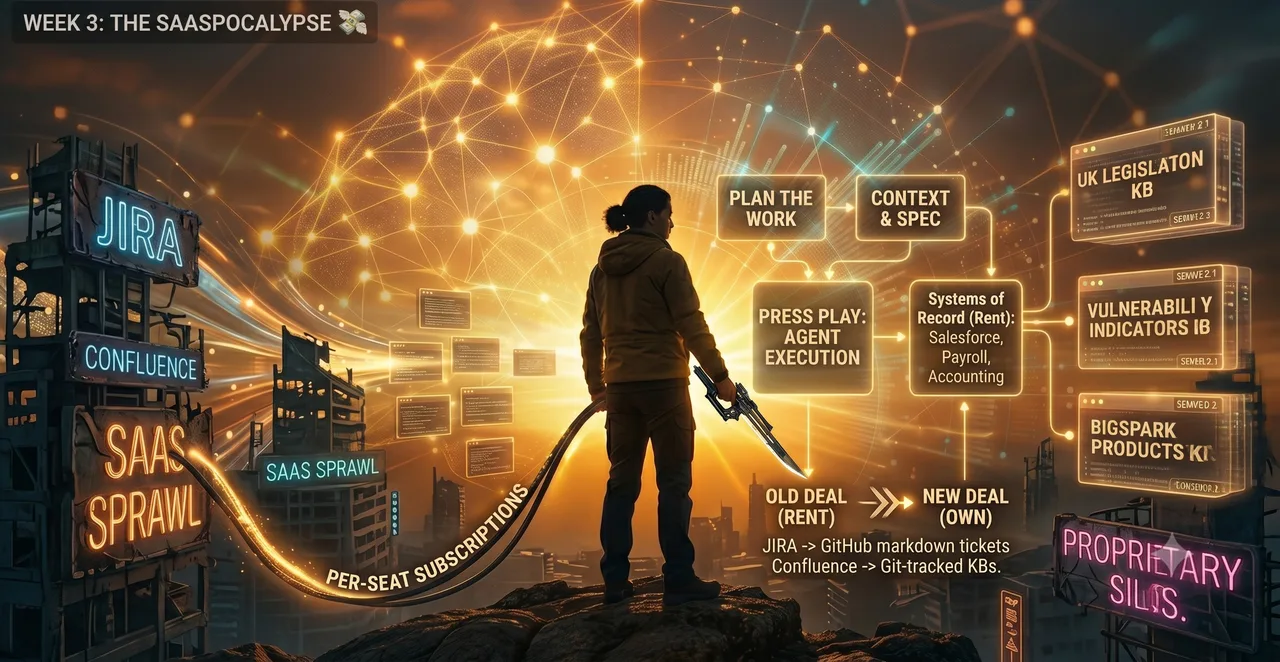
Build versus buy used to be an easy call. Building software was slow and expensive, so for anything that wasn’t your core product, you rented. That was the whole SaaS bargain: pay per seat to avoid a six-month project and a team to maintain it forever.
The moat under most SaaS products was never the software itself. It was the cost and time of building it yourself.
What changed
The same force from Article 1. AI collapses the cost and time to build.
The six-month project becomes a few days. The team to maintain it becomes one engineer working above the loop, the way I described in Article 2. When building is cheap and fast, “too expensive to build yourself” stops being a moat.
But cost was never the only reason to walk away from a SaaS tool. The bigger one only became obvious once we started building agents.
SaaS silos your data away from your agents 🔒
If your workforce is increasingly made up of agents — which is the bet this whole series is built on — then knowledge trapped in a proprietary silo is a liability.
Your agents can’t easily read your Confluence. Your tickets sit behind an API you don’t control, shaped the way a vendor decided. Every SaaS tool is a little walled garden holding a piece of your operation hostage.
In an AI-native business, owning your data layer isn’t just cheaper. It’s the point.
What we’re actually doing ✂️
Two cancellations, imminently.
Jira → GitHub. We already run our work as markdown tickets in git, with tooling to pick them up, complete them, and generate a backlog. GitHub Projects and Issues handle the tracking. The work tracker stops being a separate system and becomes part of the repo — readable by the same agents that do the work.
Confluence → knowledge bases. Our documentation becomes a GAAARS knowledge base: markdown in git, versioned and diffable, the same pattern from Article 3. We’re building a new KB type that mimics what Confluence does well — a navigable page tree — and an Obsidian-style front end to view and edit it.
That last part is the bit that matters. Confluence is a dead end for AI: content goes in, but your agents can’t easily get it back out. A markdown KB is readable by a person and an agent alike. One artefact, two consumers. The docs your team writes become knowledge your agents can use, with no export step and no integration tax.
The honest bit
This isn’t free, and it isn’t for everything.
We’re not rebuilding Salesforce. We’re not replacing payroll, or accounting, or the systems of record that are regulated, genuinely networked, or simply not worth our time. Some SaaS has a real moat, and pretending otherwise is how you end up maintaining a worse version of something you used to rent.
The rule is the same one from the bricklaying and the knowledge bases: build when it’s core and cheap, rent when it’s not. What’s changed is where that line sits. AI moved it a long way in favour of building.
And we take on the upkeep. Owning your stack means owning its maintenance, its bugs, and its 3am failures. We think that’s a fair trade for control, lower cost, and a data layer our agents can actually use. But it is a trade, and anyone telling you it’s all upside is selling something.
What’s next
The work tracker and the docs are moving in-house. What comes next week, I genuinely don’t know yet — I’ll write about whatever’s most interesting by then. That’s rather the point of doing this in real time rather than from a content calendar.
Article 4 in a series documenting bigspark’s AI-native transformation. Article 1: Staff Augmentation Is Dead. Article 2: Measure Twice, Build Once. Article 3: Knowledge is Power.